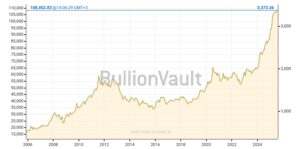


Silver is having a moment. After a wild ride that saw prices spike above $100–$120 earlier in 2026 before pulling back, the metal is trading near $68–$69 per troy ounce as of late August 2026. That is still up roughly 75–77% from a year earlier. The case for adding silver now rests on a rare combination of industrial necessity, monetary heritage, structural scarcity, and relative value.
Why buy now
Silver sits at the intersection of two powerful forces: strong industrial demand and monetary demand.
Industrial use accounts for the majority of silver consumption. The metal’s unmatched electrical and thermal conductivity makes it essential in solar panels, electric vehicles, electronics, semiconductors, power management, connectors, and increasingly AI data centers and broader electrification infrastructure. Even as technology shifts (such as certain solar cell designs) moderate some photovoltaic demand, overall industrial needs remain elevated, supported by the green energy transition, EVs, and the exploding power requirements of AI.
On the supply side, the market is in its sixth consecutive year of structural deficit. Forecasts from the Silver Institute and Metals Focus point to a shortfall of around 46 million ounces in 2026 (some earlier projections ran higher). Mine supply is largely inelastic because most silver is produced as a byproduct of copper, lead, and zinc mining. Higher silver prices alone do not quickly unlock new primary production. Cumulative drawdowns from inventories since 2021 run into the hundreds of millions of ounces. Physical investment demand (coins and bars) is expected to rise solidly, offsetting softer jewelry and some industrial segments.
Macro factors add fuel. Geopolitical tensions, elevated global government debt, persistent inflation concerns, currency debasement risks, and supportive monetary policy expectations have driven strong flows into precious metals. Silver often amplifies gold’s moves with higher volatility. Recent Treasury actions and softer yields have supported the broader metals complex.
Silver also remains accessible. At roughly $68–$69 an ounce, it is far more approachable for average investors than gold near $4,600–$4,650. It offers portfolio diversification, a hedge against fiat currency risks, and exposure to the technologies reshaping the economy. However, volatility is real. Silver can move sharply, but the fundamental backdrop of scarcity plus dual demand supports a constructive medium to long-term view for those with a multi-year horizon.
Silver’s monetary properties
Silver has functioned as money for longer than almost any other commodity. For roughly 4,000 years it served as a primary medium of exchange, unit of account, and store of value across civilizations.
In ancient Mesopotamia, silver by weight underpinned legal codes and commerce (Hammurabi’s era regulated prices and wages in silver). The Greeks minted widely trusted silver coins (Athenian “owls”). The Romans relied heavily on the silver denarius. Spanish pieces of eight, fueled by New World silver from Potosí and Mexico, became the first truly global currency. Many languages still equate “silver” with money itself. The United States operated under a bimetallic standard for much of its early history, with the Coinage Act of 1792 defining the dollar in terms of both gold and silver.
Silver possesses the classic attributes of sound money: durability, divisibility, portability (relative to its value), fungibility, scarcity, and recognizability. Unlike fiat currencies that can be created at will by governments and central banks, physical silver requires mining, refining, and real-world effort. It carries no counterparty risk—no issuer’s balance sheet or promise stands behind an ounce of .999 fine silver. When confidence in paper money or financial systems frays, silver (alongside gold) has historically attracted capital as a tangible store of value.
In the modern era, silver lost its formal monetary role as nations shifted to gold standards and then pure fiat systems after 1971. Yet its monetary DNA never fully disappeared. It remains legal tender in certain forms such as U.S. Silver Eagles, and continues to serve as “the people’s money”—more affordable and practical for everyday savers than gold. In times of inflation, currency debasement, or systemic stress, investment demand for physical silver and silver-backed products reliably rises.
The gold-silver ratio
The gold-silver ratio measures how many ounces of silver equal the value of one ounce of gold. It is calculated simply by dividing the gold price by the silver price.
As of late August 2026, with gold around $4,630–$4,650 and silver near $68–$69, the ratio sits in the mid-to-high 60s (roughly 67–68).
Historically the ratio has varied widely. In ancient and medieval times it often hovered in the 10–16 range under bimetallic systems. The U.S. Coinage Act of 1792 set it at 15:1. After the move away from formal bimetallism and the rise of fiat money, the ratio became more market-driven and volatile. Over the past century the long-run average has typically fallen in the 55–70 range, with most time spent between about 30 and 100. Modern extremes include lows near 17:1 (1980 Hunt brothers episode) and 30–32:1 (2011), and highs above 100–125:1 (1991, and especially March 2020 during the COVID panic).
A high ratio (commonly viewed as above 80) historically signals that silver is relatively inexpensive versus gold. A low ratio (below 50) suggests silver has become expensive relative to gold. Many stackers and traders use the ratio as a relative-value tool: accumulate more silver when the ratio is elevated, and potentially rotate toward gold when it compresses. Mean reversion has occurred often enough to make the metric useful, though timing is never precise and the metals can diverge for extended periods because silver carries significant industrial demand while gold is more purely monetary/safe-haven.
At current levels in the mid-to-high 60s, the ratio is near long-term modern averages—neither extreme cheapness nor extreme expense for silver. It leaves room for silver to outperform if industrial demand tightens further or investment flows accelerate, while still reflecting silver’s dual character.
Silver is not without risks. Prices are volatile, industrial demand can soften with economic slowdowns, and speculative episodes can reverse sharply. Yet the combination of a multi-year structural deficit, essential technological uses, deep monetary history, and a gold-silver ratio that does not scream “expensive” makes a compelling case.