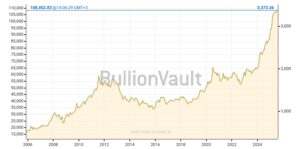


In a historic development reported by the European Central Bank (ECB) in mid-2026, gold has officially overtaken the U.S. dollar to become the worlds largest global reserve asset held by central banks. By the end of 2025, gold accounted for approximately 27% of total official foreign reserves, edging ahead of U.S. Treasuries at 22%. Central banks worldwide now hold roughly $4 trillion in gold, narrowly exceeding their holdings of U.S. government bonds. The share of euro-denominated reserve assets was unchanged at 15%.
This marks the first time in about 30 years that gold has reclaimed the top spot. This shift follows years of heavy buying by central banks and a steep rise in bullion prices over the past two years. Geopolitical tensions, concerns over U.S. fiscal sustainability, and a desire for assets independent of any single nation’s currency continue to drive this shift.
The War in The Middle East
The war in the Middle East that erupted on February 28, 2026, is no ordinary regional flare-up. Joint U.S.-Israeli strikes on Iran targeting nuclear facilities, ballistic missile sites, naval assets, and top regime figures including Supreme Leader Ali Khamenei triggered immediate retaliation. Iran unleashed missiles and drones on Israel, U.S. bases, and Gulf Arab states while effectively sealing the Strait of Hormuz, the choke-point for roughly one-fifth of global oil supply.
The conflict is still raging with no resolution in sight. The economic ripple effects are unmistakable. Oil prices are surging, inflation expectations have spiked, and global markets are pricing in prolonged uncertainty.
In this environment, capital is rotating decisively towards gold. Not because investors suddenly love shiny metal, but because every other major asset class faces structural headwinds that gold sidesteps entirely. Gold is the ultimate neutral asset. It does not pay interest, it is not controlled by any government, and it is uncorrelated to monetary policy mistakes or supply shocks. When geopolitics collides with energy markets, all roads lead to gold.
Oil Shock Meets Geopolitical Fear
The closure (or severe disruption) of the Strait of Hormuz is the single biggest driver. Higher energy costs flow straight into consumer prices, corporate margins, and central bank decision-making. Inflation fears are forcing markets to price in fewer interest rate cuts, or even interest rate hikes, in 2026. At the same time, the risk of wider escalation (involving Hezbollah in Lebanon, Houthis in Yemen, or direct superpower confrontation) keeps risk elevated across the board.
Investors respond the only rational way: they sell what can break and buy what cannot. Gold benefits from three reinforcing forces:
Safe-haven demand – during outright conflict, shrewd business people rotate capital out of affected business ventures to gold as they wait out the conflict.
Inflation hedge – energy costs embed into the prices of every commodity. Precious metal prices, and especially gold prices, benefit the most because gold has strong monetary properties that cannot be destroyed by rising inflation.
Portfolio rebalancing – high inflation transfers value from stocks and bonds to commodities. Gold prices benefit the most as investors rotate capital from what can break to what cannot break.
Consider What This Means, Asset Class By Asset Class.
Equities: The First to Crack
Stocks are getting hammered by inflation. Higher input costs crush profit margins in transportation, manufacturing, chemicals, and consumer goods. Airlines, automakers, and retailers face profit warnings; technology and growth stocks suffer from any hint of high interest rates. Energy producers may enjoy a temporary windfall, but even they cannot offset the broader risk-off mood.
Capital flees equities into cash or safe havens, until even cash looks vulnerable to inflation. Equities have no intrinsic value and their value can decline to zero when listed corporations fail. Gold, by contrast, has no earnings to disappoint and no balance sheet to impair.
Bonds: Caught Between Safety and Inflation
Government bonds are widely regarded as the safest financial investments. They have extremely low default risk, high liquidity, predictable cash flows, legal protections, safe haven status in crises, are transparent and heavily regulated. However, during periods of rising inflation, central banks raise interest rates and bond prices decline because of the inverse relationship they have with interest rates.
In extreme inflation scenarios such as those precipitated by high oil prices, currency depreciation more than offsets bond yields which leads to negative real returns. Gold offers the same appeal as bonds without the exposure to rising interest rates and inflation induced negative real returns.
Real Estate: Higher Rates, Lower Demand
Commercial and residential property alike are collateral damage. Mortgage rates and borrowing costs stay elevated longer because inflation refuses to cooperate. Economic slowdown reduces tenant demand and household formation. Office and retail vacancies rise; development pipelines freeze. In a high-oil-price world, suburban and industrial real estate tied to commuting or global supply chains suffer most. Gold requires no maintenance, no tenants, and no property taxes.
Currencies: The Dollar’s Temporary Crown
The U.S. dollar strengthens initially as the world’s reserve currency and safe-haven proxy. Yet even the dollar is not immune. Massive U.S. military spending and potential energy subsidies widen deficits and stoke domestic inflation. Emerging-market currencies, especially in oil-importing Africa, Asia and Europe, depreciate sharply as capital flees to safety. Fiat money, printed by governments entangled in the conflict, loses purchasing power. Gold, priced in every currency, becomes the neutral reserve asset that no central bank can print.
Other Commodities: Winners and Losers, But None Match Gold
Oil and natural gas rocket higher, exactly as expected from a Hormuz disruption. Agricultural commodities may follow if fertilizer and transport costs climb. Industrial metals (copper, aluminum) face a tug-of-war: short-term supply fears versus longer-term demand destruction from recession. None of these, however, offer gold’s combination of portability, durability, and universal acceptance. Silver sometimes tags along as an industrial-precious hybrid, but it lacks gold’s pure monetary premium.
Cryptocurrencies: Risk-On in Disguise
Bitcoin and its peers marketed themselves as “digital gold” during peacetime. In real geopolitical stress, they crash on risk aversion and liquidity squeezes. Regulatory uncertainty, energy consumption concerns, and correlation with tech stocks only amplify the downside. When missiles fly, investors want physical bars in vaults, not private keys on exchanges.
Cash and Money-Market Funds: Silent Erosion
Sitting in cash feels prudent during uncertainty until inflation eats 7 – 10% of purchasing power annually. Short-term T-bills or money-market funds yield something, but real yields turn negative once energy-driven inflation arrives. Gold preserves wealth without relying on any governments promise.
The Rotation Is Already Underway—and Accelerating
Early in the conflict, gold saw a sharp but brief spike followed by a decline as markets digested the dual forces of safe-haven buying and sell off to raise quick cash to plug financial holes opened by the war. That decline phase seems to have found the bottom at around $4,000 an ounce. With the war showing no signs of quick resolution – ceasefire talks stalled, proxy fronts active in Lebanon and Yemen, and oil flows still constrained – central banks, sovereign wealth funds, and institutional investors are quietly increasing allocations. ETF inflows are picking up, physical demand from Asia remains robust, and mining equities are beginning to reflect higher prices.
History is instructive. Every major Middle East supply shock since the 1970s has ultimately lifted gold’s real price. This time is no different, only larger, because the conflict is hotter, the global economy more indebted, and trust in institutions more frayed.
The Only Asset That Cannot Be Bombed, Printed, or Taxed Away
In a world of missiles over the Strait of Hormuz, fiscal blowouts, and monetary dilemmas, every other asset carries a fatal flaw. Counter-party risk, policy risk, or demand risk. Gold carries none. It does not require peace treaties, central bank pivots, or economic growth to retain value. It simply is.
As the war grinds on, investors will discover that all roads, whether paved with equity losses, bond yield spikes, currency devaluation, or real-estate vacancies, lead to gold. The rotation is not a forecast. It is already the market’s rational response to a conflict whose economic consequences will outlast the fighting itself.